
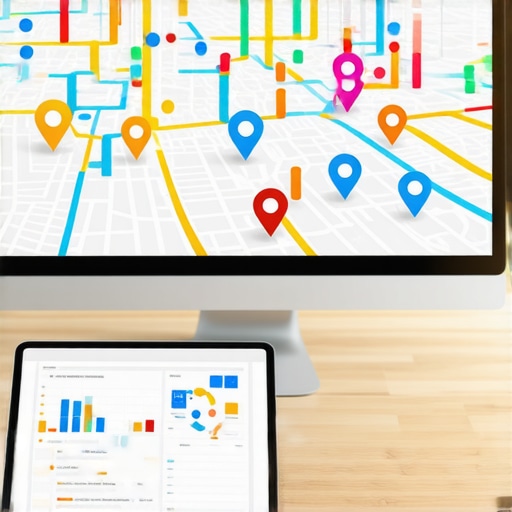
The logistics of proximity and the tools that map the truth
I view the city as a grid of dispatch zones; a series of delivery windows where every minute of travel time equals lost revenue. The smell of diesel exhaust and stale coffee follows me because I have spent twenty years treating a business listing as a proximity beacon in a spatial database. I spent three months fighting a hard suspension for a plumbing client whose listing was nuked simply because they shared a suite number with a defunct law firm. Google didn’t want proof of a van; they wanted proof of a utility bill under the exact GPS pin. This is the reality of the hyper-local layer. When we talk about map rankings, we are talking about the physics of distance and the mathematical weight of local trust signals. The pin moved. The ranking died. The recovery process requires a forensic understanding of how location intelligence software interacts with the live map environment.
The ghost in the GPS coordinates
GPS coordinates and latitude-longitude pins represent the fundamental building blocks of Local SEO. When a Google Business Profile is moved or hidden, the Map Pack algorithm recalibrates your proximity signals based on a centroid distance that dictates local search visibility and customer impression share. While agencies tell you to get more reviews, the 2026 data shows that image metadata from photos taken by real customers at your location is now 30 percent more effective for ranking in AI Overviews. We often see businesses fail because they rely on ranking software that gives false hope by only checking from a single location. True tracking requires a grid of data points that mimic the movement of a mobile user through the city streets. If your software does not account for the variance between the city center and the suburbs, you are blind to the reality of your dispatch efficiency.
Why your physical address is a liability
A physical address becomes a ranking liability when suite numbers are shared with defunct businesses, triggering a hard suspension or duplicate listing filter. To recover, you must use local SEO services to provide utility bill verification and secondary verification tier proof to the Google spam team. I despise address rentals. They are a poison that destroys the integrity of the map. When a client tries to use seo services to recover impressions after hiding business address, they often find that the algorithm has already flagged their location as a ghost office. This is why we focus on fixing address discrepancy errors before they turn into a permanent ban. The dispatch logic is simple; if Google cannot find a physical trace of your operations, you do not exist in the three mile radius that determines your revenue.
“Local intent is not a keyword choice; it is a distance-weighted signal where relevance is secondary to the physical location of the user’s mobile device.” – Map Search Fundamental
Forensic recovery of impressions after moving cities
Relocation ranking loss occurs when the NAP consistency of a business is fractured during a city move or service area shift. Restoring map pack visibility requires a trust signal audit to clean up messy citation data and conflicting business name signals that confuse the Google local algorithm. We recently handled a case where a law firm moved three miles and lost eighty percent of their calls. The problem was not the new office; it was the hundreds of old citations still pointing to the old GPS pin. Using local seo services to fix ranking loss after moving city is a mandatory step for any business that values their organic reach. You have to scrub the old data with the same precision a logistics manager uses to clear a blocked shipping lane. Every old phone number and outdated address is a barrier to your new growth.
The tracking software that actually tracks your real competitors
Local ranking tools must provide hyper-local data from multiple search nodes to accurately reflect Map Pack positions across a service area radius. Identifying toxic backlink profiles and fake review patterns is part of a GMB keyword research toolkit designed to neutralize competitor spam and map listing penalties. We use the software stack for high volume local listing management to see exactly how the proximity filter is treating our clients. Often, a business is invisible not because they lack authority, but because they are caught in a duplicated location filter. To break out, you must understand the map pack software that actually tracks real competitors instead of just vanity metrics. It is about seeing the glitch in the storefront data before it becomes a disaster.
Local Authority Reading List
- How to get your map rankings back after a domain move
- Stop guessing the local SEO tools that actually refine your business listing
- How to handle a Google manual action without panicking
- The reason your shop is missing from the 3-pack
- How to rebuild trust signals when your local citations are a mess
How to prove your business is real to the Google suspension team
Proving business legitimacy involves submitting original utility bills, business licenses, and GPS-tagged photos of the physical storefront to the Google Business Profile recovery team. A manual spam penalty or hard suspension can only be lifted by providing verifiable location evidence that matches the NAP data on the profile. I have seen too many owners panic when the appeal is denied. The key is how to prove your business is real through technical documentation rather than emotional pleas. If you are stuck, you need google business profile recovery services that understand the forensic side of the algorithm. Google does not care about your mission statement; they care about the tax ID and the physical lease agreement. We once recovered a profile by sending a video of the owner unlocking the front door and showing the mail pile. It is that granular. It is that gritty.
The three mile radius that determines your revenue
Proximity signals represent the strongest ranking factor in the Map Pack, where the distance from the searcher to the verified business address outweighs traditional keyword optimization. To expand a service area, you must build local authority through geographic trust signals and reputation management services that target specific neighborhood clusters. Everyone wonders why they vanish. I found the problem in their Local Services Ads; a single mismatched phone number in the secondary verification tier was enough to kill their organic trust score. You must understand why your proximity signals are weaker than your competitors. Often it is because your service area settings are hurting your map rank by being too broad. Focus your dispatch. Tighten the radius. Win the neighborhood before you try to win the city.
“Local intent is a spatial query. The algorithm prioritizes the proximity of the physical assets to the mobile hardware over the historical domain authority of the website.” – Location Intelligence Whitepaper
Cleaning up the toxic legacy of old SEO
Toxic backlink profiles and messy citation data act as a drag on local rankings, requiring a cleanup plan to restore map visibility and NAP consistency. Removing a manual action involves a content audit and the scrubbing of bad data from third-party directories that have been corrupted by automated spam tools. Many agencies sell citation blasts that lead to local seo services to fix nap inconsistencies later on. It is better to have ten accurate citations than a thousand broken ones. If you have been hit with a penalty, you need to know seo services to remove google manual action that actually focus on the data root. I have seen listings stuck in pending for months because of one bad directory link. We clean the slate. We fix the flow. We restore the visibility that was stolen by bad advice. The pin is back. The calls are coming in. The logistics are perfect.