
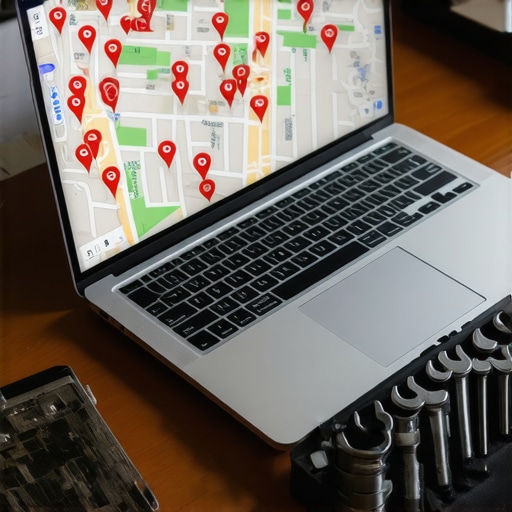
I remember the smell of wet concrete on the day the plumbing listing died. It was a cold Tuesday morning when I spent three months fighting a hard suspension for a plumbing client whose listing was nuked simply because they shared a suite number with a defunct law firm. Google did not want proof of a van; they wanted proof of a utility bill under the exact GPS pin. This is the reality of the street level strategist. I do not look at dashboards; I look at the glitches in the storefront data that suggest a business does not actually exist where it says it does. The map is a living, breathing spatial database. When you understand that a business profile is a proximity beacon rather than a static page, you start to see why most agencies fail. They focus on keywords while I focus on coordinate salience. Success in the modern map pack requires a forensic approach to data consistency and a deep respect for the mathematical weight of the user location.
The ghost in the GPS coordinates
To dominate nearby search results you must maintain absolute GPS coordinate salience through precise latitude and longitude alignment across all major data aggregators while ensuring your Google Business Profile is verified at a physical location that matches user movement patterns. This starts with the microscopic math of the centroid. When a user searches for a service from their mobile device, Google does not just look for the word plumber. It looks for the density of signals coming from your specific pin. If your coordinates are even slightly off in the underlying map layer, your visibility decays. This is why we found 4 hidden proximity errors that stop local profiles from ranking during our audits. These errors often stem from a mismatch between the rooftop of the building and the street entrance where the Google car actually drove by. If the algorithm cannot verify a clear path from the road to your front door, it lowers your trust score. We use tools to track and improve gmb rankings that allow us to see these tiny spatial discrepancies before they become ranking killers. The goal is to make the digital pin a perfect mirror of the physical reality.
“Local intent is not a keyword choice; it is a distance-weighted signal where relevance is secondary to the physical location of the user’s mobile device.” – Map Search Fundamental
Why your physical address is a liability
A physical address becomes a liability when it lacks unique identifier signals or shares a footprint with high risk categories that trigger Google algorithmic red flags for map spam. Most business owners think moving to a new office is just about the mail. For a map strategist, it is a high stakes gamble. I have seen companies lose everything because they moved into a building that previously hosted a suspended lead generation shell. The historical data of a physical location stays in the database long after the signage changes. This is where seo services to fix gmb ranking loss after address change become vital. We have to flush the old location signals and establish a new authority layer. It requires a hard reset of the local ecosystem. If you do not handle the transition with surgical precision, you end up with services to fix mismatched business address and phone number issues that haunt your rankings for years. The algorithm hates ambiguity. If it sees two different businesses claiming the same square footage without a clear suite distinction, it will simply hide both to protect the user experience. You have to prove your exclusive right to that spot on the earth.
The three mile radius that determines your revenue
Your revenue is directly tied to the three mile radius surrounding your primary business centroid where the proximity signal is strongest and your local justifications are most frequent. Proximity has replaced authority as the primary driver of map pack success in 2025. You can have a thousand reviews, but if a competitor is two blocks closer to the user, they will likely win the click. This is the physics of the local algorithm. We combat this by building out the service area pages tweak that put our business in the neighborhood map pack for surrounding zones. You have to extend your reach by proving to Google that your service vehicles are constantly active in those nearby neighborhoods. This is not about keyword stuffing. It is about behavioral data. Google tracks the movement of your employees if they have the business app open. They track the locations where your reviews are being left. If all your reviews come from people twenty miles away, Google knows you are not actually serving the local community. This is why why nearby mobile users see your competitors instead of your front-door even when you have better services. You must anchor your profile to the neighborhood through hyper-local content and geo-tagged signals.
Local Authority Reading List
- 5 Google Business Profile Tips for 2026
- 10 Non-Obvious Map Ranking Items
- The Three Block Invisibility Factor
- Fixing Sudden Map Disappearances
- Beyond Review Requests for Ranking
The forensic audit of review sentiment
A forensic audit of review sentiment involves identifying specific service keywords within customer feedback to trigger local justifications and detecting inorganic patterns that could lead to profile filtering. I have seen businesses get decimated because a competitor hired a bot farm to drop a dozen one star reviews in an hour. It is a digital drive by shooting. You need seo services to fix fake reviews issues that focus on reporting the metadata discrepancies of the accounts used. Google looks at the IP address, the local guide level, and the physical distance between the reviewer and the business at the time of the post. If someone reviews a coffee shop in Chicago while their phone is pinging a cell tower in Manila, the review will be filtered. We also focus on the review keyword trick that forces your profile into the map pack by encouraging customers to mention specific services. When a user searches for emergency water heater repair, Google scans your reviews for that exact phrase. If it finds it, it highlights that review as a justification. This is a massive trust signal. It tells the user that people like them have successfully used your service for that specific problem. It is much more powerful than a generic five star rating.
“Google Business Profile rankings are a function of the user’s distance from the business centroid, the business’s historical click-through rate for that specific coordinate, and the density of local justifications found in reviews.” – Location Intelligence Whitepaper
Why mismatched phone numbers kill trust scores
Mismatched phone numbers across the web kill trust scores because the Google algorithm relies on the Phone Number as a primary unique identifier to connect disparate data points into a single authoritative entity. In the early days, you could have five different tracking numbers and it did not matter. Now, it is a death sentence. If your website has one number, your GMB has another, and your Yelp profile has a third, Google sees three different entities. It splits your authority three ways. This is why the tweak that fixed our clients vanishing map impressions almost always involves a massive cleanup of the NAP (Name, Address, Phone) data. We use specialized local seo tools to optimize google business profile listing data to find every old mention of your business across the web. We have to find the ghost profiles on obscure directories that are leaking the wrong information. Even a single digit error in a secondary verification tier can be enough to trigger a suspension. Google wants to know that if a user clicks the call button, they will reach the exact business they see on the map. Any friction in that process results in a ranking penalty. We ensure that your primary business line is the anchor for every digital mention of your brand.
The verification loop for service area businesses
The verification loop for service area businesses requires constant proof of proximity through geo-tagged photo uploads, localized service updates, and mobile app interactions that confirm your presence within the claimed territory. If you are a locksmith or a landscaper, you are under a microscope. Google knows that the service area category is the most abused in the ecosystem. They are looking for reasons to hide you. You need to use local seo services to stabilize volatile map rankings after expansion to ensure that as you grow, your digital footprint keeps up with your physical vans. This means uploading photos of your team on the job in specific neighborhoods. These photos contain metadata. Google can see exactly where that photo was taken. If you claim to serve a city but all your photos are taken in your backyard, you will never rank in the city center. We also implement 6 specific post updates that force google to show your profile more often by focusing on local landmarks and neighborhood names. You have to prove you are a member of the community. The algorithm is moving toward a model where your rank is determined by your actual service history rather than just your office location. If you want to win, you have to show up where the work is.
How to recover a profile from a hard suspension
Recovering a profile from a hard suspension requires a comprehensive audit of your business documents to ensure they match the digital profile exactly followed by a formal appeal that addresses the specific violation of the Google Business Profile terms of service. This is the hardest part of the job. It feels like a courtroom battle where the judge is an AI. Most people fail because they use the standard form and just say please help. That does not work. You need google business profile recovery services that understand the forensic requirements. We have to provide utility bills, business licenses, and photos of your signage that leave no room for doubt. We often look at the exact appeal process we used to recover a suspended business profile to replicate success for our clients. You have to find the specific trigger. Was it a mismatched suite number? Was it a keyword stuffed name? Once the violation is fixed, you have to present the evidence in a way that the human reviewer at Google can verify in under sixty seconds. They do not have time to guess. If your documents are messy, your profile stays dead. We clean up the mess and restore the bridge between your business and the customers waiting for you. This is how we keep the phone ringing even when the algorithm tries to silent it.