
The 15-Minute Google Maps Audit to Stop Losing Phone Calls to Competitors
As a Google Business Profile Product Expert, I spend my days looking under the hood of local search algorithms. I see the same tragedy play out daily: a hardworking business owner – a plumber in Chicago, a lawyer in Miami, or a dentist in Phoenix – doing everything “right” in the real world, yet their phone remains silent. Meanwhile, a competitor with half the experience and worse reviews is drowning in leads. The culprit isn’t bad luck; it’s a systematic failure in their google business profile seo strategy that effectively renders them invisible to the very people trying to find them.
Local businesses lose thousands of potential customers every month because their GBP setup sabotages lead generation. In fact, research into local search behavior suggests that preventable mistakes on a listing can cost a business up to 70% of their potential phone calls. Most of these errors are invisible to the naked eye but glaringly obvious to Google’s crawlers. This is why I developed the “15-Minute Audit” – a professional framework designed to identify and plug the leaks in your local visibility before another lead slips through to your competition.
While deep-dive SEO can take months to yield transformative results, these “sanity checks” take minutes and can stop the bleeding immediately. We aren’t just talking about “tips”; we are talking about the technical signals that Google uses to determine who wins the Map Pack and who is relegated to page two.
Audit Step 1: The Foundation of Discoverability and NAP Consistency
The first five minutes of your audit must be dedicated to the foundation: your Name, Address, and Phone number (NAP). Google is a giant database of facts, and if those facts are inconsistent, the algorithm loses trust in your listing. When trust drops, your ranking follows.
Start by looking at your website’s footer and your Google Business Profile side-by-side. Are they identical? I don’t just mean the numbers; I mean the formatting. Does one say “Suite 100” while the other says “#100”? While Google is getting better at normalizing this data, discrepancies still create “noise” in the local graph. More importantly, check your Title Tags on your website. I frequently see businesses stuffing their brand name with city keywords in a way that looks like spam. Using a dedicated google business profile audit tool can help you identify if your brand name is being flagged for over-optimization or if there are redundant listings floating around the web that are cannibalizing your authority.
Consistency extends beyond just your own site. You need to ensure that your data is uniform across the major aggregators. If your old office address is still listed on an obscure local directory, it creates a conflict. Google’s algorithm prioritizes certainty. If it isn’t 100% sure where you are located, it won’t risk showing you to a searcher in a high-intent moment. This is why I always include these checks in our 10 non-obvious items on our Google Maps ranking checklist. If you haven’t audited your NAP in the last six months, you are likely operating with a fractured foundation.
Audit Step 2: Optimizing Your Profile for Maximum Conversion
Once the foundation is set, we move into the profile itself. To rank google business profile listings effectively, you must understand the hierarchy of categories. Your Primary Category is the single most important piece of metadata on your profile. Choosing “Legal Services” instead of “Personal Injury Attorney” is a mistake that can cost you thousands of dollars in lost cases. Google uses the primary category to define your “core” relevance. If you are too broad, you will be outranked by specialists. If you are too narrow, you miss out on volume.
Check your secondary categories as well. Many business owners leave these blank, but they are essential for capturing “long-tail” local searches. However, do not add categories that don’t apply to you; this “category dilution” can actually hurt your primary ranking. During this phase of the audit, you should also evaluate your visual assets. I’ve written extensively about the photo habit that separates top listings from the bottom 80%. Listings with recent, high-quality, and ideally geo-tagged photos see significantly higher engagement and click-through rates (CTR).
To truly understand how these profile adjustments are moving the needle, you should utilize professional local seo tools. These allow you to see the “before and after” of your optimization efforts. If you change a category or update your service area, you need to know if you are starting to rank higher on google maps for the specific neighborhoods you serve. Without data, you are just guessing in the dark. A professional google maps ranking service focuses on these micro-adjustments because, in a competitive market, a 1% increase in conversion from your profile can lead to a massive jump in monthly revenue.
Audit Step 3: Beating the 2026 Proximity Filter
The local search landscape is shifting. We are moving away from an era where “Authority” (backlinks and age) was the king of the hill. In the 2026 algorithm, “Proximity” has become the dominant signal. Google’s goal is to provide the most convenient solution to the user. This means that a competitor might outrank you simply because they are 0.5 miles closer to the searcher – even if your business is “better” by every other metric.
Understanding how proximity is replacing authority in the 2026 local SEO trends is crucial for your survival. To combat the proximity filter, you must strengthen your “hyperlocal” signals. This involves creating content and signals that tie your business to specific neighborhoods, not just the city at large. If your google business profile seo strategy only targets “Los Angeles,” you will lose to the guy targeting “Silver Lake” or “Echo Park.”
During your 15-minute audit, look at your “Service Areas” in the GBP dashboard. Are they realistic? If you claim a 50-mile radius but only have signals (reviews, photos, mentions) from a 5-mile radius, Google will see the discrepancy and throttle your reach. We call this the “Radius Signal.” By tightening your service area to where you actually do business, you often see an increase in density and visibility within that smaller circle. For those looking to dominate a wider area, you must implement specific 3 GMB elevation tactics to win the 2026 radius update, which involve localized landing pages and neighborhood-specific review acquisition.
Audit Step 4: Turning Reviews into a Lead Generation Machine
Most business owners think reviews are just about the star rating. They are wrong. While a 4.8-star average is great for social proof, the real power of reviews lies in the keywords and the metadata contained within them. Google’s AI reads your reviews to understand what you actually do. If a customer leaves a review saying, “The best emergency water heater repair in Atlanta,” Google now associates your profile with the keyword “emergency water heater repair.”
As part of your google business profile optimization, you need to audit your response strategy. Are you responding to every review? Are you doing it within 24 hours? Speed of response is a signal of business “health.” Furthermore, you should be using the “After-Service text trick.” Instead of sending a generic email three days later, send a personalized SMS the moment the job is completed. Ask the customer to mention the specific service they received. This naturally injects high-value keywords into your profile without looking like “spammy” SEO. Using a google business profile audit tool can help you track which keywords are appearing most frequently in your reviews, allowing you to pivot your service focus if necessary.
Remember, reviews are a two-way street. If you aren’t engaging, you aren’t building the “prominence” signal that Google requires to increase google business profile visibility. High-velocity, keyword-rich reviews are the fuel that powers the Map Pack Lead Generation blueprint that we use for our high-end clients.
Audit Step 5: Stop Chasing Phantom Clicks
The final step of the audit is the most painful for many: checking if your leads are actually real. Many local seo tools and “maps lead generator” services boast about “impressions” and “clicks.” But as a business owner, you can’t deposit impressions into your bank account. You need to differentiate between bot traffic, accidental clicks, and real intentional buyers.
Look at your GBP Insights. Are the “Direction Requests” coming from the zip codes where your ideal customers live? If you are a high-end kitchen remodeler but all your direction requests are coming from an industrial district or a neighboring city you don’t service, your google maps lead generation strategy is misfiring. You are likely ranking for the wrong terms or in the wrong geographic clusters.
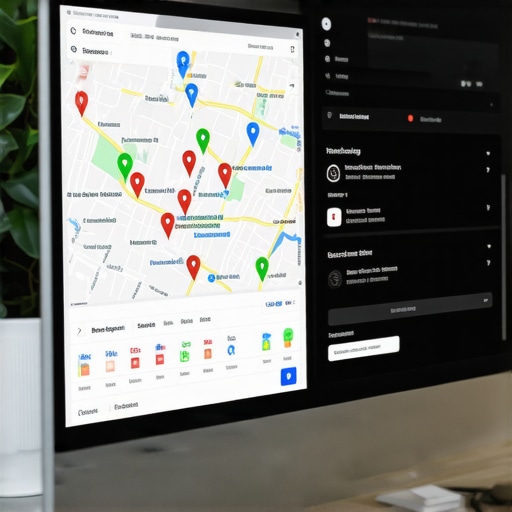
Use a professional google maps rank tracker to see a grid view of your rankings. A single “rank” number is a lie. You might be #1 at your front door and #20 two blocks away. This “grid-based” visibility audit tells you exactly where your “dead zones” are. If you see a dead zone in a high-value neighborhood, that is where you need to focus your localized content and photo uploads. Stop chasing phantom clicks and start focusing on the geographic pockets that drive actual revenue. This often involves diagnosing why your city pages are failing to drive real local map clicks and adjusting your on-page signals to match your GBP goals.
Conclusion: Your 15-Minute Roadmap to Dominance
A successful google business profile seo strategy is not a “set it and forget it” task. It is a living, breathing part of your business’s digital presence. By spending just 15 minutes a month running through this audit – checking your NAP consistency, refining your categories, monitoring proximity shifts, maximizing review signals, and verifying lead quality – you place yourself ahead of 90% of your competitors who are still relying on outdated tactics.
The local search algorithm is getting smarter, more localized, and more focused on user intent. If you aren’t evolving with it, you are effectively handing your leads to the business down the street. Don’t let preventable mistakes sabotage your hard work. Take the 15 minutes today to audit your listing, or contact me, Kevin Pauls, for a professional deep-dive audit to ensure your business remains the undisputed leader in your local Map Pack.