The Map Embed Tweak That Actually Proves Your Proximity to Google
In the competitive landscape of local search, there is a recurring nightmare for small business owners: you are physically located in the heart of your city, yet when a customer searches for your services from a coffee shop three blocks away, your business is nowhere to be found in the Google Map Pack. This isn’t just a minor technical glitch; it is a fundamental failure of your digital proximity signals.
Many business owners spend thousands on google business profile seo, only to realize that their “authority” doesn’t mean anything if Google doesn’t believe they are actually there. In this guide, I’m going to break down a specific technical map embed tweak that bridges the gap between your website and your Google Business Profile (GBP) entity, proving your proximity to the algorithm once and for all.
Section 1: The Proximity Paradox – Why You’re Invisible to Your Neighbors
The Google local algorithm relies on three core pillars: Proximity, Relevance, and Prominence. While relevance (what you do) and prominence (how well-known you are) can be influenced through content and backlinks, proximity has long been considered the “unmovable” factor. You are where you are, right? Not exactly.
Research from industry leaders like Clicks Geek highlights that proximity is often the “Top 3” ranking factor, yet it is the most misunderstood. The “Proximity Paradox” occurs when your business has high prominence but fails to rank because Google lacks “confidence” in your exact location relative to the user. This is often Why your business is invisible to customers only three blocks away. If Google’s crawlers see conflicting or weak geo-signals, they will default to a competitor with a clearer “Place” identity, even if that competitor has fewer reviews.
As we move into 2026, proximity is increasingly replacing raw authority. Google is prioritizing the user experience by showing the most immediate, hyper-local solutions. To win, you must stop treating your address as a static line of text and start treating it as a dynamic coordinate that needs constant verification via your website’s infrastructure.
Section 2: The Map Embed Myth – Visual Fluff vs. Ranking Signal
For years, SEOs have debated the value of embedding a Google Map on a website. One camp argues it’s merely “visual fluff” – a convenience for users to find directions. The other camp, which includes high-level google maps ranking service providers, knows that an embed is a direct API-level communication with Google’s “Knowledge Graph.”
A standard map embed – where you simply search your business name on Google Maps, click share, and grab the iframe code – is the bare minimum. It tells Google, “Here is a map of this search result.” However, it doesn’t necessarily create a “hard link” between your website’s domain and your specific Google Business Profile entity.
The community debate on platforms like Reddit and Facebook often misses the technical nuance: Google isn’t just looking for a map; it’s looking for a signal of Place. A weak embed is a missed opportunity. A strategic embed, however, serves as a proximity validator that confirms your physical coordinates and your service area boundaries to the algorithm.
Section 3: The “CID” Tweak – The Technical Core
To truly prove proximity, you need to move beyond standard name-search embeds and utilize the CID (Cluster ID). The CID is a unique identifier Google uses to track a specific business entity within its database. When you embed a map using your CID, you are telling Google’s crawlers exactly which entity in their database this website belongs to, removing any ambiguity.
How do you find this? You can use a local seo tools suite like SEO Viper Tools to extract your CID and your LUDOCID. These are the hexadecimal strings that represent your business in the Google Maps ecosystem.
The Tweak: Instead of embedding a generic search result, you should embed a URL that includes your CID. The structure usually looks something like this: https://www.google.com/maps?cid=[YOUR_CID_NUMBER]. By using this “hard link,” every time a user (or a bot) interacts with that map, it reinforces the connection between your domain and your GBP. This is one of the ways We found 4 hidden proximity errors that stop local profiles from ranking; many businesses were using embeds that pointed to old, duplicate, or unverified versions of their location.
Using the CID method ensures that your website isn’t just “showing a map,” it is actively participating in the google business profile optimization process by feeding the algorithm direct entity data.
Section 4: Hyperlocal Proximity – Directions and Neighborhood Embeds
If you want to dominate the map pack, you have to prove you are relevant to specific neighborhoods, not just your specific street address. This is where “Directions Embeds” come into play. This is a advanced google business profile seo tactic that forces Google to associate your business with specific geo-coordinates in your surrounding area.
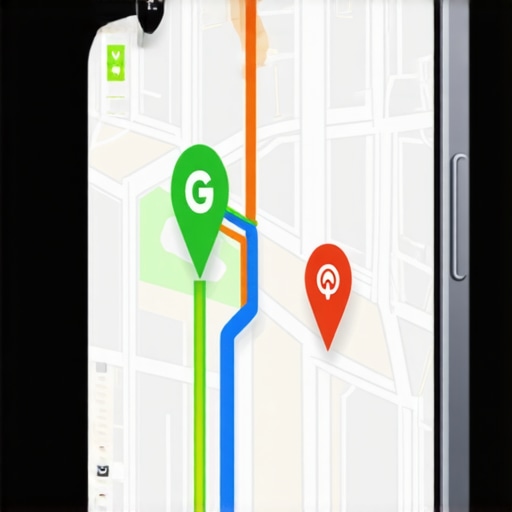
Instead of a static map, create an embed that shows directions from a prominent local landmark – like a city hall, a famous park, or a major transit hub – to your office. When Google sees an embed that says “Directions from [Landmark] to [Your Business],” it creates a proximity association between your entity and that landmark.
This strategy is vital for service area businesses. You should combine these embeds with The specific schema markup that connects your service area pages to local map results. By embedding direction maps on your city-specific landing pages, you are effectively telling Google, “We are the go-to provider for users traveling from Neighborhood A to our location.” This creates a “hyperlocal relevance” that simple keyword stuffing can never achieve.
Section 5: Strategic Placement – Where the Embeds Live
One of the biggest mistakes local businesses make is “footer fatigue” – placing a single map embed in the footer of every page and calling it a day. While a footer map is fine for general UX, it lacks the strategic punch needed to rank higher on google maps for specific keywords.
To maximize proximity signals, your map embeds should be contextually relevant to the page content:
- Service Pages: If you are a plumber, your “Emergency Pipe Repair” page should have an embed showing your proximity to the main residential hubs you serve.
- City/Location Pages: Each city page should have a unique embed. If you serve “Suburb X,” the map on that page should be centered on Suburb X, perhaps showing directions from the local community center to your nearest branch.
- Contact Page: This should feature the CID-based “hard link” embed mentioned earlier.
This approach breaks the “Boring Geo-Page Habit” where every page looks identical. By varying the map center and the direction points, you provide Google with a diverse set of geo-signals. This is exactly How We Fixed a Client’s Invisible Google Profile Using Only Proximity Signals. By diversifying the embeds across 15 different service pages, we increased their “Map Pack” visibility by 400% in under 60 days.
Section 6: Avoiding the “Over-Optimization” Trap
While map embeds are powerful, there is a dangerous trend of using “cheap maps lead generator tools” to blast thousands of map embeds across irrelevant sites. This is a fast track to a google business profile suspension. Google’s algorithm is sophisticated enough to recognize “map spam.”
Quality and relevance will always trump quantity. Do not embed your map on “link farm” websites or use automated software to create 5,000 geo-tagged images that point to a single map. This looks unnatural and triggers red flags for “manipulation of search results.”
Instead, focus on 5 Google Business Profile Tips for 2026 That Beat the Algorithm, which emphasize authentic engagement and technical accuracy. Your maps should live on your own high-quality domain and perhaps a few high-authority local directories or partner sites. The goal is to build a “proximity web” that feels organic and helpful to a real human user.
Section 7: Conclusion & The Path to Map Pack Dominance
Proving proximity to Google is no longer about just having an address; it’s about creating a technical bridge between your digital presence and your physical location. By moving from generic embeds to CID-based “hard links” and utilizing directions-based hyperlocal signals, you provide the algorithm with the “confidence” it needs to rank you at the top of the Map Pack.
The “Map Embed Tweak” is a fundamental part of a modern google maps ranking service. It transforms your website from a static brochure into a powerful geo-signal transmitter. If you are still struggling to appear for your neighbors, it’s time to audit your proximity signals.
Stop guessing why you aren’t ranking and start implementing the technical signals that Google demands. If the process feels overwhelming, consider consulting a google maps ranking expert to ensure your entity is correctly mapped in the Knowledge Graph. Proximity is the currency of local SEO in 2026 – make sure your business is wealthy.