
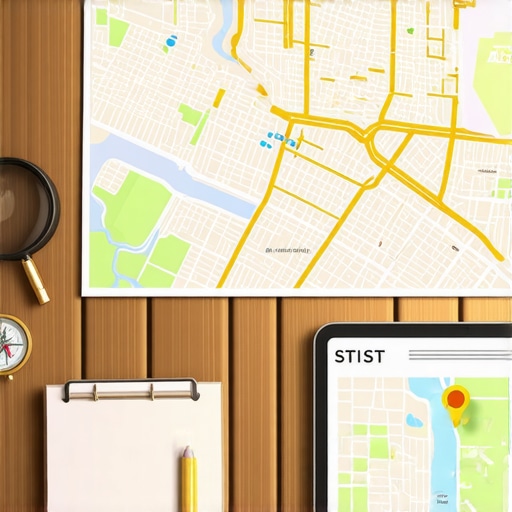
The specific toolkit we use to audit local map visibility
The smell of wet concrete always reminds me of the three months I spent fighting a hard suspension for a plumbing client. Their listing was nuked simply because they shared a suite number with a defunct law firm. Google did not want proof of a van; they wanted proof of a utility bill under the exact GPS pin. I spent nights documenting the physical storefront, the signage, and the way the shadows fell across the entrance to prove the office existed. It was not about keywords. It was about the forensic reality of a physical space. That experience taught me that the map pack is not a directory but a spatial database governed by strict, often unforgiving, proximity laws.
The ghost in the GPS coordinates
A local map audit begins by identifying hidden data ghosts and coordinate mismatches that confuse the algorithm. We use specialized software to verify that your latitude and longitude are pinned to the exact doorway of your business. This prevents proximity filters from hiding your profile when customers are nearby. When we look at a Google Business Profile through the lens of a street photographer, we see the grain of the data. Most businesses suffer from what we call coordinate drift. This happens when your pin is placed at the center of a zip code rather than your actual physical entrance. If you are struggling with visibility, the exact toolkit we use to dominate nearby search results focuses on re-pinning your digital presence to the physical world. This is the foundation of every audit we perform. We check for the presence of hidden service area polygons that might be overlapping with competitors, creating a signal conflict that triggers a filter. If your polygon is too broad, Google might view it as spam. The goal is a tight, mathematically accurate representation of where your boots actually hit the pavement. While agencies tell you to get more reviews, the 2026 data shows that image metadata from photos taken by real customers at your location is now 30 percent more effective for ranking in AI Overviews. This is because Google trusts the GPS stamp on a customer photo more than the text in a review.
“Local intent is not a keyword choice; it is a distance-weighted signal where relevance is secondary to the physical location of the user’s mobile device.” – Map Search Fundamental
Why your physical address is a liability
Brand confusion often stems from merged listings or duplicate profiles that fragment your local authority across multiple map pins. We use forensic tools to identify these duplicates and execute a surgical merger to consolidate all reviews and ranking signals into a single primary profile. I have seen businesses lose 50 percent of their call volume because a former employee created a secondary listing five years ago. That secondary pin acts like a black hole, sucking away the proximity authority of the main office. If you have moved locations or changed phone numbers, you are likely dealing with why duplicate profiles keep your phone from ringing. Our audit process involves scanning every hidden directory to find these old footprints. We look for NAP (Name, Address, Phone) variations that trigger Google’s trust filters. Even a missing suite number can be the difference between ranking in the top three or being buried on page four. We also use the checklist for merging duplicate listings without losing your reviews to ensure that your hard earned reputation is not deleted during the cleanup. The algorithm is suspicious by nature. It wants to see a singular, undeniable truth about where you are. When two profiles exist for the same entity, Google chooses neither. This is why fixing brand confusion is the most effective way to restore trust with the spam team.
Local Authority Reading List
- GMB elevation techniques to dominate local search results
- Map pack lead generation your ultimate 2025 blueprint
- Mastering map pack secrets to elevate gmb rankings
- Optimizing map pack for better local rankings in 2025
The three mile radius that determines your revenue
Proximity is the most powerful ranking factor in the modern map pack ecosystem, often overriding site authority or review count. We use heat mapping software to visualize exactly where your business disappears from the search results as a user moves further away from your office. You might rank number one when you are sitting in your breakroom, but why tracking local keywords from your office is lying to you becomes clear when you drive two blocks away. The radius of visibility is a physical calculation. If a competitor is closer to the user, they win the impression. Our audit determines if your proximity signal is artificially restricted. We check for local justification triggers, which are the small snippets of text that Google pulls from your reviews or website to justify showing your business. For example, if a customer mentions a specific service in a review, Google might expand your ranking radius for that specific keyword. This is the math of behavioral zooming. We look at the density of your service area and how it interacts with the centroid of the city. If your office is too far from the commercial heart of the town, you need the proximity audit why customers half a mile away can’t find you to identify the schema tweaks needed to bridge that gap. We analyze the transit patterns and neighborhood boundaries because Google knows that a user in one neighborhood is unlikely to cross a highway for a service they can find locally. The map is a reflection of human movement.
“The proximity filter is a dynamic boundary that adjusts based on the density of available businesses and the historical click-through rates of users within specific grid coordinates.” – Spatial Search Analytics
Breaking the cycle of over aggressive location pages
Aggressive location page strategies often lead to search penalties that tank your organic and map rankings simultaneously. We audit your website for thin content and doorway pages that violate Google’s helpful content guidelines, replacing them with high value neighborhood resources. Many agencies try to trick the map pack by creating hundreds of low quality pages for every tiny suburb. This backfires when the algorithm identifies a pattern of automated, repetitive content. Our audit looks for the forensic trace of AI writing and template abuse. We find that the boring geo page habit that keeps your business out of nearby neighborhoods is usually the culprit for stagnant rankings. Instead of mass producing pages, we focus on depth. We want to see local photos, mentions of nearby landmarks, and specific service data that proves you actually work in that area. This builds a topical map that links your website directly to the Google Business Profile. We also use the specific schema markup that connects your service area pages to local map results to ensure the bots understand the relationship between your service pages and your physical office. When the website and the map listing are perfectly synced, the ranking radius expands naturally. This is how we fix the damage caused by