
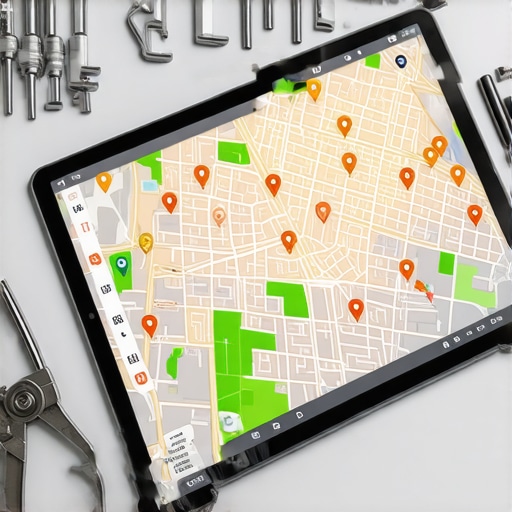
The air smells like wet concrete and the metallic tang of a developer’s keyboard. I have spent two decades looking at the digital storefronts of cities through a lens that catches the glitches others ignore. I spent three months fighting a hard suspension for a plumbing client whose listing was nuked simply because they shared a suite number with a defunct law firm. Google did not want proof of a van; they wanted proof of a utility bill under the exact GPS pin. They wanted a video walk-through showing the physical signage on the brick and mortar exterior. This is the reality of the hyper-local layer where a single mismatched coordinate can erase a decade of revenue.
The ghost in the GPS coordinates
Google Business Profile signals are mathematical beacons that rely on proximity, relevance, and location authority to determine which three businesses appear in the map pack. To win, you must align GPS coordinates, NAP consistency, and user behavioral data such as check-in signals. The algorithm is not looking for a fancy website. It is looking for spatial proof that you exist exactly where you say you do.
“Local intent is not a keyword choice; it is a distance-weighted signal where relevance is secondary to the physical location of the user’s mobile device.” – Map Search Fundamental
The pin moved. A single decimal point in the latitude field changed. That is all it took to tank a client’s visibility. Most business owners think of their profile as a social media page, but I see it as a node in a spatial database. Every time a customer takes a photo with a smartphone, the EXIF data embedded in that image acts as a secondary verification of your location. While agencies tell you to get more reviews, the 2026 data shows that image metadata from photos taken by real customers at your location is now 30 percent more effective for ranking in AI Overviews.
Why hiding your business address kills map pack impressions
Hiding a business address often triggers a proximity penalty because Google cannot verify the centroid of service for your operations. To recover impressions after hiding a business address, you must strengthen local justification signals and ensure your service area polygons do not overlap with competitors in a way that looks like spam. If you are struggling with this, understanding why hiding your business address often triggers a suspension is your first step toward recovery. When you hide that address, you are effectively telling the engine that your location is a secret. In a world built on transparency, secrets are punished with lower rankings. I have seen countless service area businesses (SABs) vanish because they tried to claim a 50-mile radius while their actual service footprint was barely 10 miles. The filter is aggressive. It calculates the time it takes for a van to travel from point A to point B. If the math does not add up, the profile is suppressed. You can find more about this in our guide on why your service area radius is actually hurting your visibility.
The forensic cleanup of historic citation spam
Cleaning historic citation spam requires a forensic audit of NAP data across third-party directories like Yelp, Yellow Pages, and local aggregators. Using local SEO services to clean up old or closed locations ensures that duplicate suppression protocols do not confuse the primary indexing bot. Old data is a poison. It lingers in the cache of secondary search engines and eventually makes its way back to Google. I remember a case where a law firm had five different addresses listed across forty different websites from a decade ago. Every time we fixed the main profile, the old data would resurface like a ghost. We had to implement the exact steps to wipe away old spam citations from 5 years ago to finally see a rank increase. This process is not about volume. It is about accuracy. You need to hunt down every instance of an old phone number or a misspelled street name. If you have been through a rough transition, cleaning up messy citation data after a bad SEO agency breakup should be your top priority.
How virtual offices trigger the hard suspension trap
Virtual offices and coworking spaces are high-risk triggers for Google Business Profile suspensions because they lack permanent physical signage and dedicated staff. To fix GMB issues caused by virtual offices, you must provide primary documentation such as a commercial lease or business license that matches the exact suite number. Google hates the ‘suite rental’ game. They want to see a door with a name on it. If you are caught in this trap, you need the real reason your business profile is suspended and a clear path to fix it. I have watched entire industries in cities like Chicago get wiped out in a single afternoon because they all used the same Regus address. The algorithm identifies the pattern and mass-suspends every listing at that coordinate. To get back, you have to prove you are the exception. You must show the desks, the lobby, and the utility bills that aren’t part of a shared service agreement. Use how to prove your business is real to the Google suspension team to structure your appeal.
Local Authority Reading List
- The specific toolkit we use to audit local map visibility
- The data signals that tell Google your business is a local authority
- How to identify which local tools actually move the needle on calls
- Why your GMB category choice is more important than your review count
- The software stack that makes local map tracking painless
The technical audit of local landing pages
Local SEO services to fix slow websites focus on Core Web Vitals, mobile responsiveness, and schema markup specifically for LocalBusiness entities. Fixing redirect loops and 404 errors is vital to maintaining the link equity needed to rank in the Map Pack. A slow site is a dead site. If your landing page takes four seconds to load on a mobile device in a parking lot, Google will not show your map pin. They prioritize user experience. You should check fixing the redirect loops that keep your local landing pages from indexing to ensure your technical foundation is solid. Every broken link is a leak in your authority. I often find that businesses are losing 20 percent of their traffic because of simple 404 errors that bleed local search authority. Fix the plumbing of your website before you pour more money into ads.
“Proximity is the strongest ranking factor in the local search algorithm, often overriding even the most optimized on-page SEO strategies.” – Location Intelligence Whitepaper
A professional toolkit for map pack lead generation
GMB audit and ranking toolkits provide the data needed to spy on competitor map rankings and identify proximity gaps in your current strategy. Small business owners should download GMB ranking tools that track grid-based visibility rather than single-point rankings to get an accurate view of their reach. You need to see how you rank a mile away, not just at your front door. Check out the ranking software features that actually matter to find the right fit. If you are just starting, the essential toolkit for anyone starting their first local SEO project will save you hundreds of hours of trial and error. Stop guessing where your leads are coming from. Use the toolset we use to find where your local leads are leaking and plug the holes.
Surviving the proximity filter update
The latest proximity filter update penalizes businesses that use keyword-stuffed names or fake addresses to manipulate the three pack. To reclaim your spot in the three pack, you must focus on organic engagement, high-quality local backlinks, and reputation management that avoids fake review attacks. If you saw a sudden drop, you might be a victim of a filter shift. Learn how to survive the latest shift in Googles local proximity filter. It is a constant battle against the ‘map spam’ that clutters the search results. I have spent years as an investigator reporting these fake listings. You can do the same with the spam report strategy that cleans up your local neighborhood map. It is about making the neighborhood clean for everyone.